



Continuous inkjet
A PRINTER FOR EVERY APPLICATION
Everyone is familiar with continuous inkjet printing (CIJ), whether consciously or unconsciously. It has become an integral part of the world of labeling systems. It can be found on eggs, bottles and other everyday packaging, but also on components in automotive production or on cables.
The reason: precise and fast product marking with low ink consumption.

CONTINUOUS INKJETS - NON-CONTACT PRINTING TECHNOLOGY
Precise and fast product marking with low ink consumption. Continuous inkjet printers are used in an industrial context in particular. These devices use tiny ink droplets to produce a high-quality print image. There is no direct contact with the material to be printed. Instead, the ink droplets are transported through the air over distances ranging from a few millimetres to several centimetres. The precision of the technology allows numerous commercial applications on almost all surfaces. Whether on packaging, bottles or components in automotive production - high-performance marking systems often rely on CIJ printers from leading brands such as Hitachi.
CIJ PRINTERS - MANUFACTURERS AND MODELS
Here, you will receive high-performance printers from continuous inkjet manufacturer Hitachi. The Hitachi UX and Hitachi UX2 models ensure an efficient and trouble-free production process. They provide solutions that are the perfect fit for diverse companies and industries.
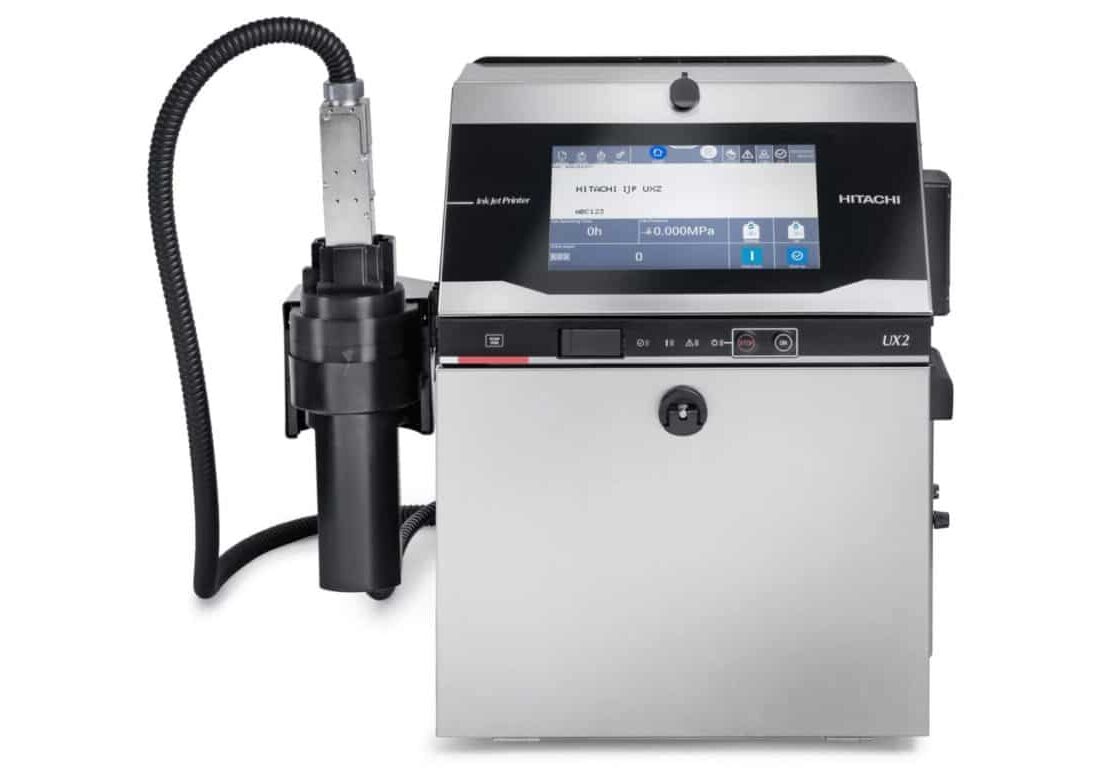
Hitachi UX2
The UX2 series from Hitachi has been developed to meet all the requirements of digitized marking.
The high-end model impresses with its ease of use, continuous availability and comprehensive connectivity.

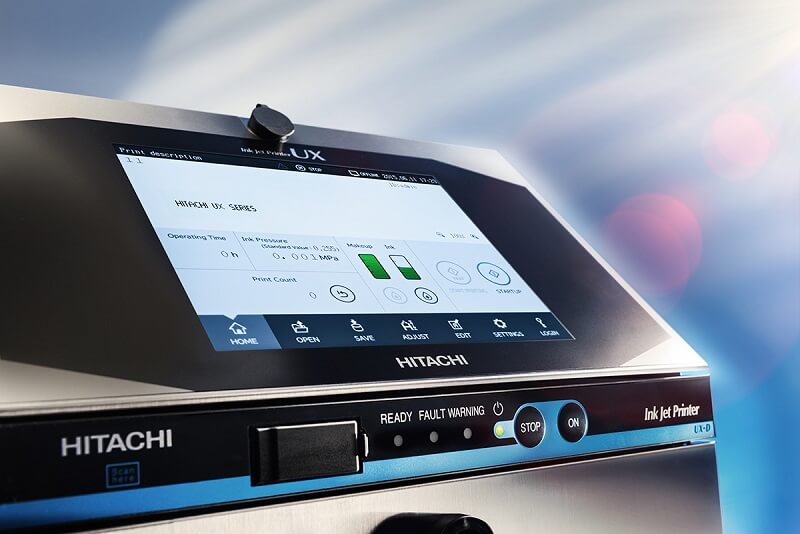
Hitachi UX Series
Hitachi UX is the traditional manufacturer’s answer to the contemporary requirements of the digital industry.
The device offers the best marking quality and the usual precision in industrial applications. Nine different models range from entry-level to high-end.
Continuous inkjet: How it works
The functionality of a continuous inkjet printer is based on a continuous ink jet or ink flow - hence the name. It works by continuously pumping ink through a nozzle and breaking it down into tiny, uniform drops using a piezo element or ultrasonic vibrations. These droplets are then electrically charged by a charging electrode and precisely directed onto the print material using deflection electrodes. The droplets reach a speed of 70 to 90 km/h. The diagram shows the individual components of the printing system and how they interact with each other.

Functions of the components shown above in detail:

CONTINUOUS INKJET:
PRACTICAL APPLICATION EXAMPLES
The following application examples illustrate the relevance of contactless printing technology in industrial processes. Continuous inkjet is used when barcodes, 2D codes, OCR, best-before dates, batch numbers and consumer information need to be automatically applied to packaging or other products.
The continuous inkjet (printing) process guarantees a high-quality print image on the substrate. Products and packaging to be printed can be made of almost any material. For example, paper, cardboard, foil, glass, plastic or metal.
In summary, continuous inkjet is suitable for high-quality, efficient and cost-effective product marking in trade and the packaging industry.
CONTINUOUS INKJET - GREATER BENEFITS THAN INDUSTRIAL PRINTS
Continuous inkjet has numerous advantages as a technology. In particular, the non-contact marking, the enormous printing speed and the low ink consumption of the printing technology should be mentioned. Thanks to the electrostatically charged ink droplets and their lightning-fast, precise deflection, all conceivable and rapidly changing print content can be output. There is no need for complex retooling to print different information or motifs.
ADVANTAGES OF CONTINUOUS INKJET
COMPARISON: LASER PRINTING VS. CONTINUOUS INKJET
| Merkmal | Laserdruck | Continuous Inkjet |
|---|---|---|
| Costs | efficient | Very efficient |
| Mobility | no | Yes |
| Security | Protection of employees required during operation | No protective measures necessary during printing |
| Flexibility | Different laser systems required for varying surfaces | suitable for almost all surfaces, depending on the printing ink |
FREQUENTLY ASKED QUESTIONS ABOUT CONTINUOUS INKJET TECHNOLOGY
Do you have further questions? You can find more details here.
The term continuous inkjet describes a modern printing technology in which there is no direct contact with the surface to be printed. Instead, the materials to be printed are guided past the print head of the CIJ printer on the production line. The printed image is created by the targeted shooting and deflection of tiny ink droplets based on physical processes.
Get in contact with us
We are here for you.

Competent contact persons

Response within 48 hours

Non-binding inquiry
Contact us directly via our contact form or use the contact details below during our business hours.
Tel.: +49 (0)931 25076 0
Tel.: +34 937 376 264
Fax: +49 (0)931 25076 50
E-mail: info@diagraph.de
Business hours
Monday - Thursday: 8:00 - 17:00
Friday: 8:00 - 14:00