



CO2 laser marker
Robust and versatile CO2 laser marking for precise, industrial markings

What is a laser marker?
A laser marker is a versatile laser that can engrave and mark various materials using laser technology. The laser is usually based on carbon dioxide and is therefore called a CO2 laser.
CO2 laser markers are used for marking, engraving and cutting materials such as wood, glass, metal or plastic. The precise and permanent marking makes the laser a real all-rounder.
The CO2 laser was developed in the USA back in 1964 and initially had an output of just one milliwatt. This was the starting point for further development towards more powerful laser coders. Within a few years, the laser was also released for commercial use. The Hitachi CO2 Laser Coder LM-C301 Series available from us more than meets today's standards with its robustness, versatility and high performance.
LM C-301 - Laser coder
Robust, versatile and powerful
The new LM series from HITACHI offers a powerful CO2 laser with flexible configuration of wavelengths, power and focal length.
This laser enables optimum marking results on various materials such as paper, cardboard, glass, plastic, anodized aluminium and wood.
An innovative design ensures high reliability and low power consumption.


Compact design and easy integration
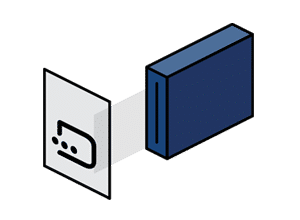
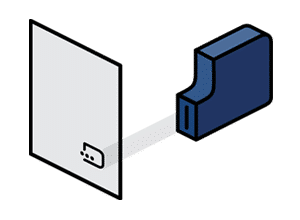
Simple mechanical integration thanks to space-saving, one-piece construction and compact design.
Freely programmable inputs and outputs enable easy connection to all packaging machines and data systems.
Highest print quality and speed
Highest print quality at production speeds of up to 600 characters per second with vector and dot matrix fonts and user-friendly font editor.


User-friendly operation and powerful software
Powerful Windows software for network operation, status control and text layout with TrueType fonts, barcodes, 2D codes and logos.
User-friendly user interface: PC-based or operable with optional 10-inch color touchscreen.
For dusty ambient conditions
The housing is IP54-certified and an optional airflow keeps the lens clean at all times.

How the CO2 laser marker works
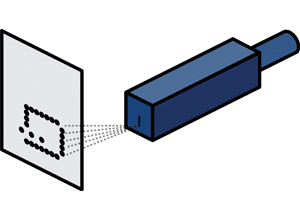
In laser marking, electromagnetic waves in the megahertz range are introduced into a gas mixture of carbon dioxide, nitrogen and helium. This excites the CO2 molecules and raises them to a higher energy level. The resulting beam of light is focused and then passed through a series of mirrors and lenses to create precise markings on the material. The depth and quality of the markings can be customized by adjusting the laser parameters.
Product advantages & disadvantages
LM C-301 laser coder
Print sample

We will be happy to produce free samples on your packaging material.
Please contact us here contact us here.
Application examples for laser markers
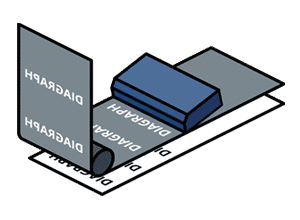
In industry, lasers are used for marking various types of packaging, e.g. paper, cardboard, glass, plastics, wood, anodized aluminium.


Suitable surfaces for CO2 laser markers
Laser markers are versatile tools that are suitable for marking a number of materials and surfaces. The following surfaces can be processed with the Hitachi LM C-301 laser coder:

Organic materials
Wood, paper and cardboard, leather, textiles, rubber

Glass & Ceramics
Standard for all types of glass and ceramics

Plastics
Acrylic (PMMA), polycarbonate and other transparent plastics, coated plastics

Metals
Coated metals, fiber-reinforced plastics (GFRP and CFRP)

food
Fruit and vegetables
What our customers say
In the past, the labeling on our pallets was often difficult to read and we had a lot of rejects.
Since we have been using Diagraph printers, every pallet receives a perfect print image and we have been able to reduce our labeling costs by 50%.
Ingo Mönke, Chairman of the Board PALETTEN-SERVICE Hamburg AG
The production process has improved considerably:
increased production, higher quality, zero rejects and avoidance of downtime during order changes,
as these now take place immediately, safely and reliably.
Pablo Blanco, Managing Director of Embalajes Blanco, Murillo de Río Leza, Spain
Technical data
| Daten | LM-C301S (ohne Strahlaufweiter) | LM-C301P (mit Strahlaufweiter) |
|---|---|---|
| Laser technology | CO2 laser, laser class 4 | CO2 laser, laser class 4 |
| Laser power | 30 W | 10 - 30 W |
| Laser wavelength | 10.6 µm (e.g. paper, cardboard, glass) | 9.3 - 10.6 µm (e.g. PET, OPP, PP, PE, paper, cardboard, glass) |
| Marking range (mm) | 40 x 40 to 100 x 100 | 40 x 40 to 250 x 250 |
| Laser auxiliary beam (optional) | Red LED, wavelength 655 nm, laser class 2 | Red LED, wavelength 655 nm, laser class 2 |
| Laser closure | Electromechanical shutter | Electromechanical shutter |
| Enclosure protection class | IP 54 | IP 54 |
| Dimensions (H x W x D) | 216 x 179 x 747 mm | 196 x 148 x 728.5 mm to 216 x 179 x 747 mm |
| Beam leakage | 0° or 90° | 0° or 90° |
| Weight | 22 kg | 18 - 22 kg |
| Laser status display | Ready (green) / Marked (blue) / Alarm (orange) | Ready (green) / Marked (blue) / Alarm (orange) |
| Energy supply | AC100 - 120 V, AC200 - 240 V (50 / 60 Hz) | AC100 - 120 V, AC200 - 240 V (50 / 60 Hz) |
| Energy consumption | 600 VA | 300 - 600 VA |
| Environmental conditions (operation) | 5 - 40 °C / 35 - 95 % rH (condensation and freezing not permitted) | 5 - 40 °C / 35 - 95 % rH (condensation and freezing not permitted) |
| Steuerungmöglichkeiten | |
|---|---|
| User interface | Touchscreen (optional) / laser application software for PC (optional) |
| Interfaces | Ethernet, WLAN, I/Os |
| Standard print functions | Barcodes (UPC, GTIN, Code 128 etc. Datamatrix, QR code), logos, time, date, user variables |
Videos about the CO2 Laser Coder LM C-301

The 5 most important advantages of the Hitachi LM C series
- Compact design
- Vertical and horizontal alignment possible
- Highest print quality
- User friendliness
- Supports vector and dot matrix fonts

LM C-301 - easy to operate
- User-friendly:
PC-based or can be operated with an optional 10-inch color touchscreen. - Powerful software:
For network operation, status control and text layout with TrueType fonts, barcodes, 2D codes and logos.
Frequently asked questions about CO2 lasers
Do you have further questions? You can find more details here.
A CO2 laser provides precise and permanent markings that are suitable for a wide range of industrial applications. It improves the traceability of products and increases efficiency in production.