



The most important facts in brief
- Printing technologies transfer texts, images or patterns onto a wide variety of materials. Depending on the area of application, these must meet different requirements, e.g. in logistics or production.
- Laser processes mark permanently and abrasion-resistant and work at high speed, which makes them ideal for industrial applications.
- Thermal transfer printing systems are suitable for marking packaging and labels in industry as they are robust and durable.
- To find the ideal printing solution for your requirements, seek advice, check recommendations from manufacturers and use tools such as our product finder.
What are printing technologies?
Printing technologies include various processes for transferring colors or ink to materials such as paper, plastic or metal. These include classic methods such as offset and gravure printing as well as modern digital printing processes such as inkjet and laser printing. Thermal transfer, inkjet and laser marking are also widely used in industrial marking. These technologies are used for packaging, labels, advertising materials and industrial markings, whereby quality, speed and material requirements play a role.
Applications of modern printing technologies
- Modern printing technologies are used in many industries as they offer a flexible and efficient solution for various requirements. The possible applications are diverse and include, among others:
- Labeling, packaging and marking in the food industry food industry
- Labeling and packaging in the beverage industry
- Labeling and packaging in the pharmaceutical industry
- Printing of cosmetic products and drugstore articles
- Labeling in pallet production and economical pallet labeling
- Labeling in the chemical industry
- Optimization in warehouse automation
The most important printing technologies in detail
Modern industrial processes require precise and reliable printing technologies in order to mark products and packaging efficiently. Each technology has its own specific advantages and areas of application, whether for small series or large-scale applications. From flexible inkjet technology to robust thermal and laser-based systems, these solutions offer a wide range of possibilities. In this section, the most important printing technologies are presented to give a clear overview of their functions and areas of application.
Inkjet printing technologies
Inkjet printing technologies are known for their versatility and precision. They work with a fine inkjet that is applied to the print material without contact. This technology is ideal for marking products at high speed and with razor-sharp results. Whether barcodes, text or graphics - inkjet printers offer maximum flexibility in design and adaptation to different materials and requirements.

Thermal inkjet
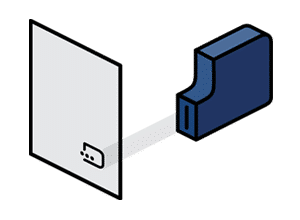
Thermal inkjet (TIJ) is an inkjet process in which ink is shot out of the nozzle by heating it up to 300 °C. This non-contact printing process enables precise and high-quality print images on various materials such as cardboard, plastic and metal. TIJ printers are easy to handle and are particularly suitable for smaller quantities.

Inkjet printer
Inkjet printers work with inkjet technology, in which ink is applied to the print medium in fine droplets. They are versatile and can be used to print text, barcodes and graphics on various materials. In industry, they are often used for product marking and packaging labeling.

Continuous inkjet
Continuous inkjet (CIJ) is a non-contact printing process in which a continuous ink jet is broken down into fine droplets and electrically charged. These droplets are precisely directed onto the print material, enabling high printing speeds and flexible applications on almost any surface. CIJ printers are particularly widespread in industrial coding and marking. Proven devices include the following models Hitachi UX2 and Hitachi UX which impress with their reliability and versatility.
Laser technologies
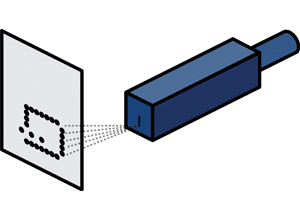
Laser technologies offer a particularly durable and precise way of marking. The non-contact nature of the process produces high-quality, abrasion-resistant markings that are suitable for a wide variety of materials. CO2 laser markers are particularly popular in industry as they are low-maintenance and can be easily integrated into existing production lines. This technology impresses with its speed, accuracy and durability.

CO2 laser marker
CO2 laser marker use a CO2 laser beam to permanently mark materials such as paper, glass, plastic and wood. This non-contact process offers high precision and long-lasting markings. The compact design and simple integration make CO2 laser markers ideal for industrial applications.
Thermal printing technologies
Thermal printing technologies are proven solutions for industrial applications where durability and high print quality are important. They are based on the transfer of color pigments using heat, resulting in extremely sharp and durable markings. These technologies are particularly widespread in the packaging and labeling industry. They are characterized by reliability, high speed and versatility in the choice of materials.

Thermal transfer printer
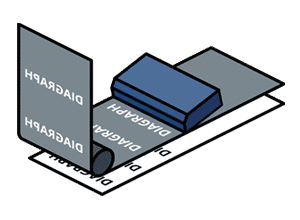
Thermal transfer printer use heat to transfer color pigments from a ribbon to the print medium. This process produces razor-sharp and durable print images that are particularly suitable for industrial labels. Thermal transfer printers are reliable, low-maintenance and offer high print quality on various materials. Diagraph offers the models ALL NGT and Allen XL5000which work with thermal transfer printing technology.

Hot stamping machine
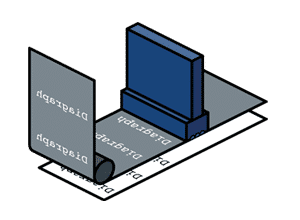
Hot stamping machine are analog coding systems that use heat and pressure to transfer color pigments from a ribbon to the material to be marked. They are robust and are ideal for fast applications with high cycle rates of up to 800 prints per minute. Hot stampers have been tried and tested for decades and are used in various industrial sectors. The Hot Stamping Machine Allen S-Compact delivers the best print quality if you prefer to use Hot Stamping Machine technology in your production.
Special printing systems
Special printing systems such as large character printers were developed for specific requirements in industry. They are used, for example, in logistics or for marking packaging where clear and highly visible labeling is required. With their ability to print precisely and clearly on large areas, they are an indispensable part of modern production and packaging lines.

Large character printer
Large character printer are designed for marking large surfaces and packaging. They enable the application of clearly legible text and logos on materials such as cardboard, wood or plastic. These printers are particularly indispensable in logistics and production to ensure clear and visible markings. The ResMark 5000 from Diagraph is the perfect large character printer for industrial product marking.
Which printing technology is the right one?
Choosing the right printing technology depends on various factors, such as purchase and operating costs, printing speed and quality. Inkjet printers offer high color quality, but are slower and require more maintenance. Laser printers are characterized by fast printing speeds and low page costs, while thermal printers are particularly robust and cost-effective to operate. The right technology should be selected depending on requirements.
To quickly find the perfect printer for industrial coding and marking, use our product finder.
Conclusion: Which printing technology suits your needs?
Choosing the right printing technology depends heavily on your individual requirements. A comparison of the various technologies and sound advice will help you make the best decision. Important points such as print volume, choice of material and costs should be taken into account. Experienced manufacturers support you in the selection, implementation and maintenance of your printing systems so that your processes run smoothly and efficiently - for long-term success and top results.
FAQ
Do you have further questions? You can find more details here.
What is a printing technology?
A printing technology comprises processes for transferring texts, images or patterns onto various materials, such as paper, plastic or textiles, using mechanical or digital methods.