



Printing bottle labels explained simply
Bottle labels are the "business card" of a bottle. They provide important information such as ingredients, expiration dates or manufacturer information and make a product clearly recognizable. At the same time, their design and material make a decisive contribution to brand impact. Modern printing technologies ensure that labels are precise, durable and easy to read - even when exposed to moisture or temperature fluctuations. In this way, bottle labels not only ensure compliance with legal requirements, but also quality, transparency and recognition in the retail sector.
The most important facts in brief
- Bottle labels are far more than just labels - they convey quality, provide important product information and are a central component of brand communication.
- Legally required information such as ingredients, quantities, best-before dates or manufacturer information must be clearly structured and permanently legible on the label.
- Excellent print quality, sophisticated design and durable materials are particularly important for wine labels, as emotional brand value plays a major role in addition to function.
What are bottle labels?
Bottle labels are special markings that are applied directly to the bottle material - usually glass or plastic. Whether wine, mineral water, spirits or other beverages: a professional bottle label conveys quality, provides information such as ingredients, barcodes or best before date and supports your brand. Bottle labels are therefore an indispensable part of product labeling.
The importance of bottle labels
Anyone who wants to print bottle labels is often faced with the challenge of choosing the right technology to ensure precise positioning and to take different materials and requirements into account. The labels not only have to be correct in terms of content, but also have to impress in terms of design, durability and legibility. For example, they must be resistant to moisture, temperature fluctuations or mechanical stress - depending on the type of product.
Bottle labels play a central role in product labeling and brand presentation throughout the beverage industry. They are not only a practical means of conveying information, but also a decisive factor in the first impression that consumers gain of a product.
Printing bottle labels - What information needs to be on the label?
A bottle label contains important information that is both legally required and important for the consumer. The standard information includes:
- Product name
- Brand name
- Ingredients (e.g. sugar, water, flavors)
- Nutritional information (e.g. calories, fat content, sugar, protein)
- Quantity/volume (e.g. 500 ml, 1 l)
- Alcohol content (for alcoholic beverages)
- Best before date or use by date
- Manufacturer details (name, address, contact of the manufacturer or distributor)
- Barcode or QR code (for product identification)
- Batch number (for traceability)
- Safety and health instructions (e.g. "Protect from light", "Not suitable for children")
- Storage instructions (if necessary, e.g. "Store in a cool place")
This information is not only necessary for legal reasons, but is also important in order to gain the trust of consumers and guarantee the quality of the product.
Print expiration dates on bottle labels with the Hitachi UX2
For printing expiration dates on bottle labels, the Hitachi UX2 inkjet printer is an excellent choice. With its precise CIJ (Continuous Inkjet) printing technology, the UX2 enables fast and accurate printing of expiration dates and other variable information directly onto labels. This technology guarantees high print quality at high speed, making the UX2 particularly suitable for continuous printing of bottle labels.
Thanks to its high resolution, companies can ensure that the best-before date remains both clearly legible and durable. The UX2 is ideal for printing labels on flat surfaces and can also be used on malleable materials, which are often used for bottle labels. This allows you to ensure that important information such as the best-before date appears on the labels in the highest quality and with long-term legibility.
The PA7100 Print and Apply Labeler for bottle cartons
The PA7100 Print and Apply Labeler is not suitable for labeling bottles directly, as it cannot be applied to bottles accurately enough due to its single-color printing technology and high speed. However, the PA7100 is ideal for labeling bottle cartons. These stable, less flexible cartons benefit from the PA7100's high printing speed and variable print data. The PA7100 provides a fast and efficient solution, particularly when labeling bottle cartons, which often have to be labeled in small batches or with short changeover times. However, bottles themselves require more precise positioning and controlled speed, which the PA7100 cannot offer due to its design and speed.
Special features of wine label printing
Printing wine labels differs from labeling other products in several ways. Above all, the design requirements are higher, as wine labels not only convey functional information, but also serve as an important marketing tool. A wine label must often create an emotional connection with the consumer and emphasize the brand identity and exclusivity of the product. The printing process for wine labels is therefore usually complex and requires high-quality materials and printing techniques that also work well on specialized papers, such as textured or recycled material. The durability of the label is also an important factor, as wine bottles are often stored for long periods of time and the label must be able to withstand both moisture and changing temperatures, without losing its legibility or appearance.
Labeling wine cartons with the ResMark 5000
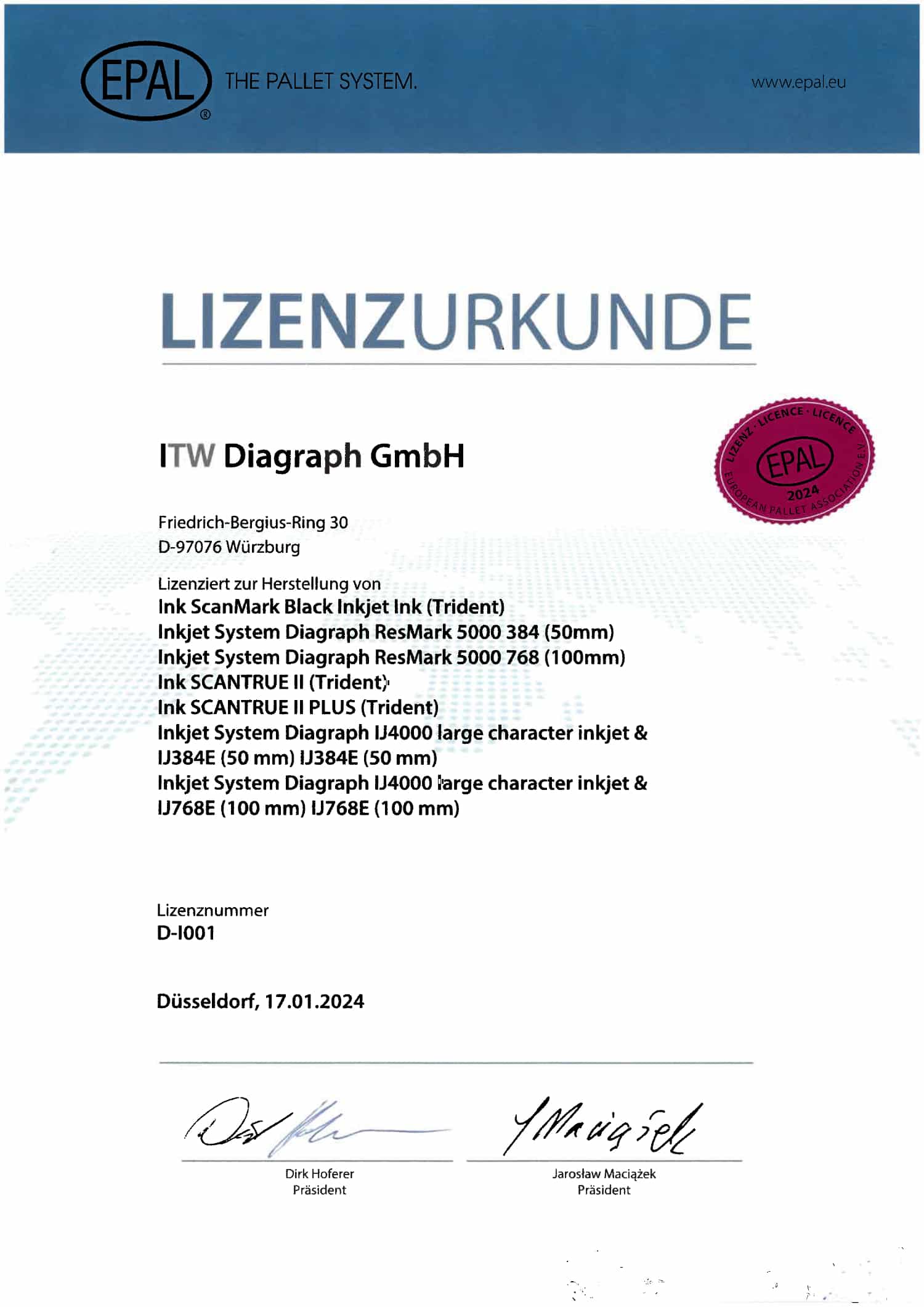
In addition to label printing, the marking of wine cartons also plays an important role in logistics. With the ResMark 5000 large character printing system, wine cartons can be printed directly and in high resolution - completely without labels. The ResMark 5000 enables razor-sharp print images up to 100 mm high and is ideal for displaying logos, text, barcodes or variable data. Thanks to its robust design and integration into industrial production lines, the ResMark 5000 provides a reliable, low-maintenance and cost-effective solution for direct printing on cardboard packaging - even with high cycle rates and changing layouts.
Conclusion
Diagraph offers you the right solutions for labeling your products, both for bottles and bottle cartons.
The PA7100 offers an excellent solution for labeling bottle cartons. This print dispenser is particularly suitable for the fast and precise labeling of cartons containing bottles. Thanks to its high printing speed and flexible printing options, the PA7100 is ideal for companies that need to label large quantities of cartons efficiently and with consistent quality.
When it comes to bottle label printing requirements, such as best-before dates and other important product information, the Hitachi UX2 is the perfect choice. This printer ensures both high speed and precision, making it an ideal solution for efficient bottle labeling.
FAQ
Do you have further questions? You can find more details here.
What is a bottle label?
Bottle labels are special markings that are applied directly to bottles to display product information such as ingredients, nutritional values, best-before dates or brand logos. They are not only used for information, but also for brand presentation.