



Definition and function of the Data Matrix code
The Data Matrix code consists of an arrangement of light and dark cells arranged in a grid. A continuous line at the edge (the so-called clock pattern) is used for alignment during scanning. The data contained is encrypted using a special error correction process (ECC 200). This means that the code can still be read even if parts are damaged or dirty. This makes the DMC particularly robust and reliable - even in harsh industrial environments with oil, dust or mechanical abrasion.
Advantages of Data Matrix
The Data Matrix code offers numerous practical advantages that make it the preferred choice in many industries:
- Compact size: It requires little space and can also be mounted on very small products or components.
- High data density: A DMC can contain complex information such as serial numbers, batches, expiration dates or URLs.
- Robustness: Thanks to integrated error correction, the code remains readable even if damaged.
- Versatility: It can be applied directly to metal, plastic, glass or paper.
Data matrix & QR code in comparison
Both the Data Matrix code and the QR code belong to the family of two-dimensional (2D) barcodes. Unlike classic barcodes, they store information not just in one line, but in a square or rectangular pattern of black and white modules (small boxes).
Data Matrix codes usually appear more compact and consist of many small square cells with a characteristic "L-shaped" frame for orientation.
QR codes, on the other hand, are usually somewhat larger, have three distinctive orientation points in the corners and are often used on product packaging, flyers or websites.
Here is a comparison of Data Matrix vs. QR code:
| Merkmal | Data-Matrix Code | QR-Code |
|---|---|---|
| Typical application | Industry, mechanical engineering, medical technology | Consumer goods, advertising, mobile communication |
| Space requirement | + Very compact, ideal for small areas | - Requires more space with the same data |
| Fault tolerance | + High error correction performance (ECC200) | - Slightly lower error correction |
| Surface compatibility | + Suitable for difficult, reflective materials | - Less suitable for industrial engraving |
| Scanner compatibility | - Not every smartphone recognizes it immediately | + Readable from practically all smartphones |
| Awareness / distribution | - Less well known to the public | + Very widespread in everyday life |
Beispiel eines Data Matrix-Codes im direkten Vergleich zum QR-Code. QR-Codes sind im Konsumentenbereich weit verbreitet, während DataMatrix-Codes vor allem in Industrie und Logistik eingesetzt werden.

DataMatrix-Code

QR-Code
Areas of application for Data Matrix codes
Data Matrix codes are used in a wide variety of industries.
- In the automotive industry, they are used for component identification and traceability.
- They are used in medical technology to mark instruments, implants and packaging.
- The pharmaceutical industry uses this technology for serial numbers and product verification.
- In electronics production, they are used for printed circuit boards, microchips and device components.
Data Matrix vs. other 2D barcodes in comparison
In addition to the widely used QR code, there are other 2D barcodes such as PDF417 or Aztec, each of which offers different strengths. In the industrial environment, the Data Matrix code is particularly impressive:
- In contrast to the QR code or PDF417, Data Matrix requires significantly less space, which is a great advantage, especially for small components.
- Data Matrix uses a powerful Reed-Solomon error correction that compensates for damage better than many other codes, for example better than PDF417 in harsh environments.
- While QR codes are often used in the consumer sector, Data Matrix is widely anchored in standardized industrial processes, e.g. through ISO/IEC 16022 or GS1.
Other codes such as Aztec score points for their fast readability in mobile applications, and PDF417 is particularly suitable for larger data volumes that can hardly be accommodated in the Data Matrix. Nevertheless, the Data Matrix code is often the most efficient choice for small, robust markings.
Layout and structure of a matrix code in detail
A Data Matrix code consists of several important elements that together ensure that information can be stored and read securely and reliably:
- Data cells: These are the small black and white boxes that you see in the code. Each box represents a specific piece of information - together they form the actual data.
- Watch pattern: On two sides of the code there is a continuous line of black boxes that looks like a frame. This pattern helps the reader to align the code correctly and recognize where it begins and ends.
- Edge zones (quiet zone): There is a small free area around the code without pressure - this is the quiet zone. It ensures that the scanner can clearly distinguish the code from the background.
- Error correction: The code contains special additional information that can compensate for errors during reading, for example if the code is damaged or dirty. This error correction is based on a mathematical process called Reed-Solomon, which is particularly reliable.
The size of the Data Matrix code adapts to the amount of data stored. It can be either square or rectangular, depending on how much space is available and how much information needs to be encoded.
How do you read a Data Matrix code?
Das Auslesen erfolgt mit sogenannten Data Matrix-Code Scannern. Diese Geräte – stationär oder mobil – erfassen das Rastermuster und interpretieren die codierten Informationen. Wichtig ist eine gute Ausleuchtung und ein ausreichender Kontrast zwischen Code und Hintergrund. Moderne Scanner können auch beschädigte oder verschmutzte Codes zuverlässig lesen. In industriellen Prozessen werden oft Hochleistungskameras mit integrierter Prüftechnik eingesetzt, die den Code nicht nur lesen, sondern gleichzeitig auf Richtigkeit und Qualität überprüfen.
Create a Data Matrix code: How it works
Zur Erstellung eines Data Matrix-Codes wird spezielle Software eingesetzt, in die relevante Daten wie Artikelnummern, Verfallsdaten oder Seriencodes eingegeben werden können. Die Software berechnet daraus automatisch den passenden Code inklusive Fehlerkorrektur. Je nach Verwendungszweck wird der Code anschließend gedruckt, graviert oder gelasert. Dabei ist es wichtig, dass die eingegebenen Daten normgerecht strukturiert sind, beispielsweise GS1-konform, und dass der Code den jeweiligen Platzverhältnissen angepasst wird. Vor der Serienproduktion sollte unbedingt eine Testlesung durchgeführt werden, um sicherzustellen, dass der Code fehlerfrei gelesen werden kann.
Industrial direct marking with Data Matrix code
With direct marking, the code is permanently applied directly to the material - without labels or additional carriers. Typical processes are
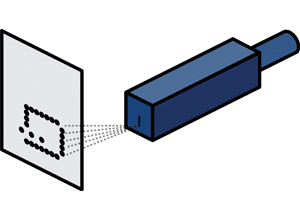
- Needle embossing (dot peen): The surface is deformed at certain points by a fine point - particularly suitable for metals.
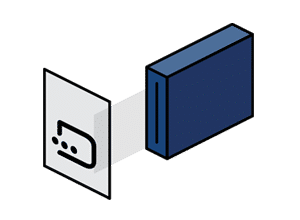
- Laser engraving: The code is burned in with a laser beam - ideal for materials such as plastic, metal or glass.
- Electrolytic marking: A chemical-electrical process that is often used for stainless steel.
The dot patterns created by needle embossing are visually similar to a data matrix code, but do not represent standardized coding. They are particularly robust against environmental influences, but are less precise in their representation. For industrial applications with high requirements for reading accuracy, conformity to standards and traceability, the Data Matrix Code (DMC) is generally the better choice.
Print Data Matrix code
Different printing technologies are used depending on the surface and material:
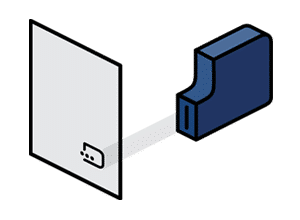
- Thermal Inkjet: Ideal for paper, cardboard and absorbent surfaces. The prints are sharp and quick to implement - even in multi-shift operation.
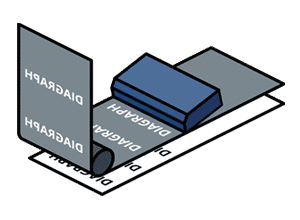
- Thermal transfer printer: Particularly suitable for flexible packaging and films. The prints are smudge-proof and durable.
- CO2 laser marker: For permanent and non-contact marking on metal, plastic or glass - without any consumables.
- Labeling systems: When variable content is to be applied to labels and applied automatically.
In addition, control systems ensure legibility by automatically verifying the print quality - a must in safety-critical industries.
Challenges and common sources of error
Despite the many advantages, there are some typical challenges and sources of error when using data matrix codes. For example, readability suffers if the modules of the code are too small or the contrast between the code and the background is insufficient, such as with light codes on a light background or dark codes on a dark background. Incorrect alignment, for example if the code is twisted or positioned at an angle, can also lead to reading errors. In addition, an incorrect data structure, such as invalid characters or incorrect separators, can cause problems during scanning. To counteract this, clean printing processes, regular quality assurance and the use of suitable scanning technology are crucial.
Conclusion: Why Data Matrix is the future of labeling
Data Matrix codes have become an integral part of industrial marking. They offer maximum data security in the smallest of spaces - with full machine readability. With the right technology, DMCs can be integrated into any production process - efficiently, in line with standards and future-proof. Those who rely on Data Matrix today create the basis for transparent processes and traceability at the highest level.
FAQ
Do you have further questions? Here you can find more details.
What is a Data Matrix code?
A data matrix code is a two-dimensional barcode consisting of small, square modules. It stores data in a space-saving manner and is particularly suitable for industrial applications where precise and machine-readable identification is required.